Intact Core Technology
Overview
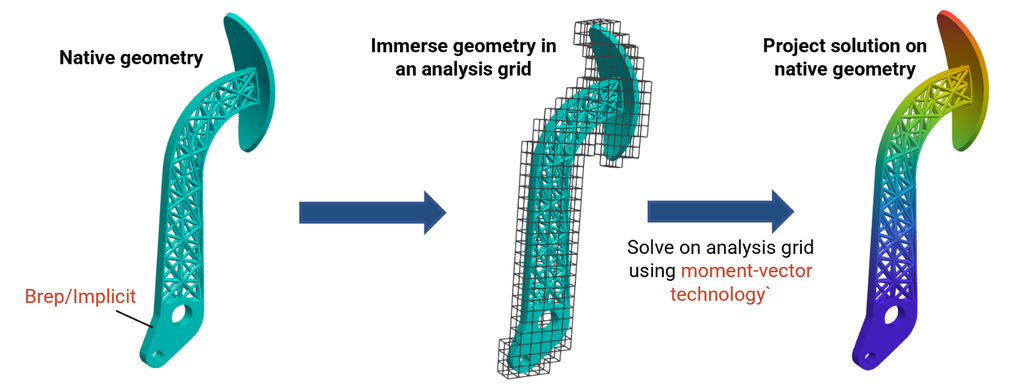
The Immersed Method of Moments (IMM) is Intact’s meshfree simulation technology that eliminates meshing in finite element analysis. Instead of requiring the geometry to be discretized, IMM immerses it in a structured background grid and performs robust numerical integration using custom quadrature rules tailored to each boundary-intersecting cell. This approach enables simulation directly on native geometry—whether it’s CAD, implicits, tessellations, voxel data, g-code paths, CT scans, or any combination—without meshing. IMM delivers accurate, automated, and representation-agnostic simulation, streamlining workflows from early design through final inspection.
Meshing is the Bottleneck: While well-constructed finite element meshes can offer excellent performance, the process of generating them remains a major bottleneck. Creating a conforming mesh requires manual effort, domain expertise, and meshing often fails for increasingly complex geometries from, for example, generative design. These limitations make simulation workflows fragile, hard to automate, and slow to iterate. For analysts, this means hours spent fixing mesh artifacts, refining local elements, or translating geometry into compatible formats. For designers, meshing disrupts rapid design iteration, slows innovation, and prevents seamless integration into computational and generative design pipelines. In short, meshing limits the speed, scalability, and flexibility of modern simulation workflows.
IMM’s Core Methodology
IMM resolves these limitations through three key innovations:
Immersed Grid: The geometry is embedded in a background grid whose cells (elements) do not need to conform to the shape of the geometry. Grid cells that lie completely outside the geometry are disregarded, while those entirely inside are treated as standard Hex finite elements. Boundary cells, those partially intersecting the geometry, receive special numerical treatment.
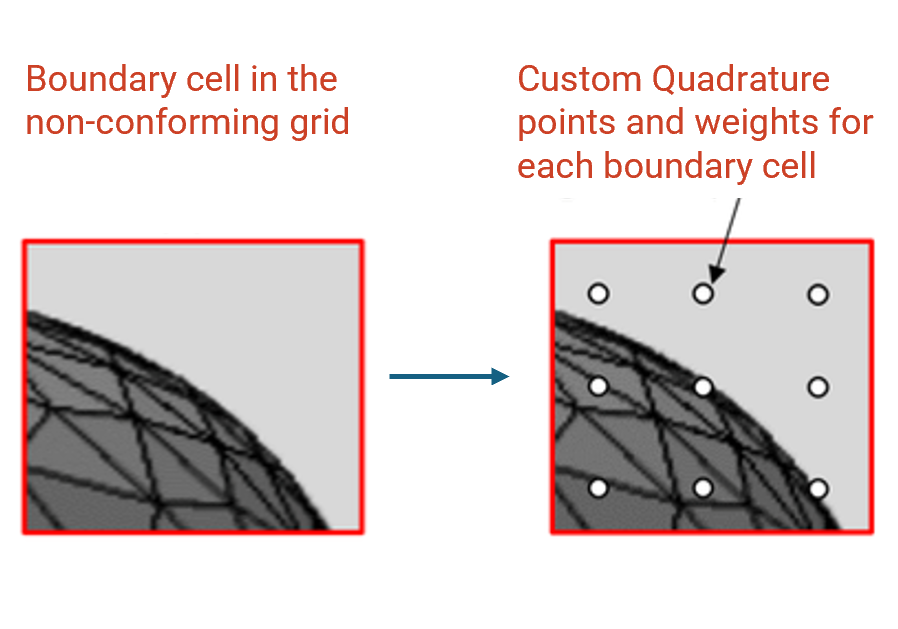
Moment-Based Quadrature: For boundary cells, instead of relying on heuristics (like adaptive sampling or density-scaled integration), IMM performs precise integration using moment-based quadrature. Numerical quadrature rules are constructed by matching the integrals of basis functions (moments) over the cell’s intersected domain. The quadrature order can be increased for accuracy or reduced for speed—just like in traditional FEA.
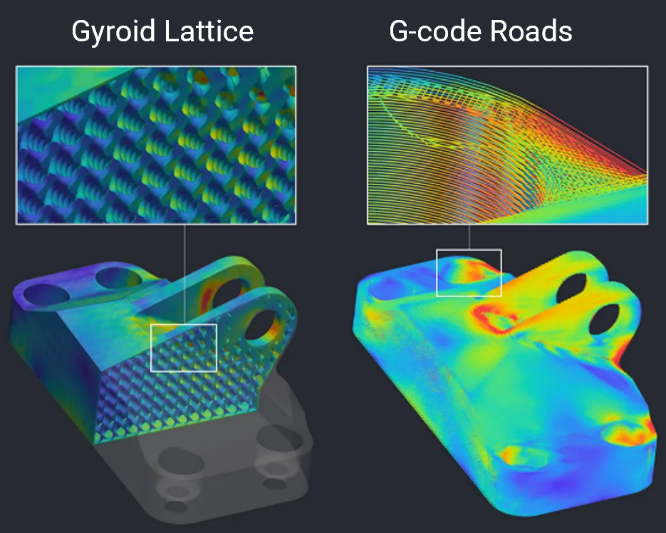
Representation-Agnostic Input: Because IMM operates through moment integration, it supports a wide range of geometry representations so long as the volume enclosed by the representation can be computed. This includes not only traditional formats like CAD (B-reps), tessellations (e.g., STL/PLY), and voxel data, but also non-traditional inputs such as implicits, G-code toolpaths, and CT scan reconstructions. This flexibility makes IMM highly adaptable to modern design and manufacturing workflows.
Mathematical Underpinnings
IMM can accurately simulate any geometry, without relying on conforming meshes. The key is that the moment-fitting quadrature rule preserves the integrals that define the system physics—just like Gauss quadrature but generalized to any shape.
Why Quadrature Matters: A quadrature rule approximates an integral by evaluating the function at a few strategic points (called quadrature points), weighted appropriately. For example, an \(n\)-point Gauss quadrature rule in 1D integrates all polynomials up to degree \(2n - 1\) exactly. In this sense, the rule is “fitted” to match the moments of monomials like \(0,\ x,\ x^{2},\ ...,\ x^{2n - 1}\) over the integration domain. These integrals of monomials (\(M^{k} = \ \int_{\Omega}^{\ }x^{k}d\Omega\) ) are the moments and they encode essential geometric and analytic information about the domain.
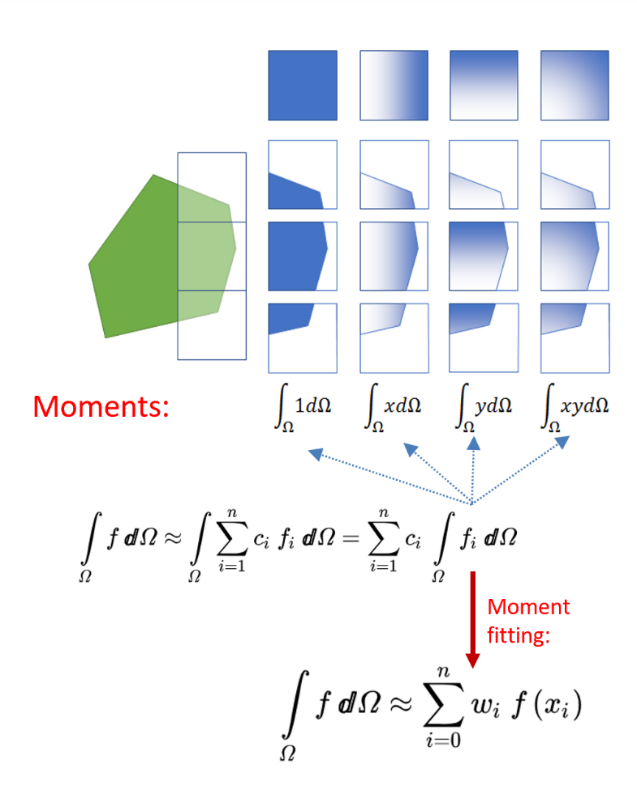
Moment Fitting Generalizes Quadrature: Quadrature rules are, in essence, lumped representations of mass that preserve certain integrals, i.e., moments. Gauss quadrature is one such rule, optimized for standard shapes. But when dealing with irregular or non-conforming domains, like in IMM, these standard rules break down. Instead, IMM uses a process called moment fitting, where quadrature rules are constructed on the fly for each boundary cell by solving a system of equations.
These quadrature rules are designed to preserve key integrals (moments) up to a desired order, ensuring accurate integration even when the cell is only partially filled by the geometry. This results in a custom quadrature rule for each boundary cell which preserves the same mathematical fidelity as Gauss quadrature, but adapts to complex, arbitrary shapes.
Other Advantages of IMM
Composability: Moments are additive across disjoint domains. This enables efficient reuse and simulation of hybrid or multi-representations geometries.
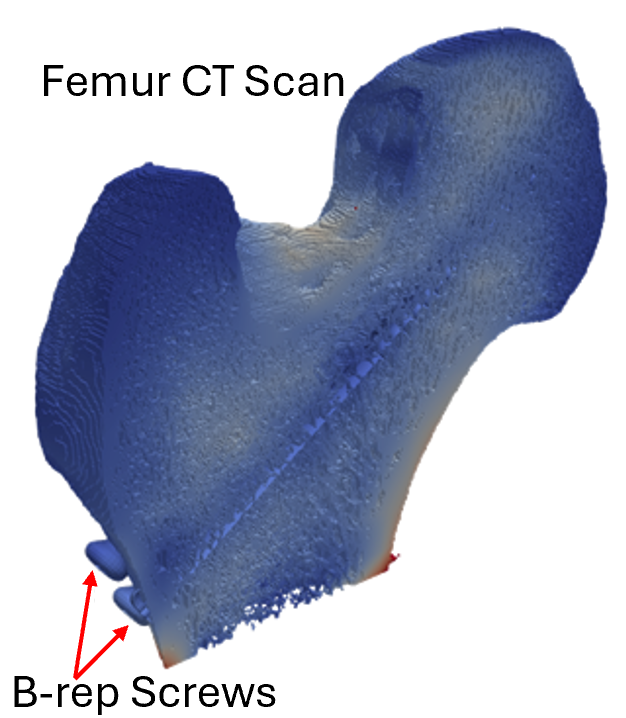
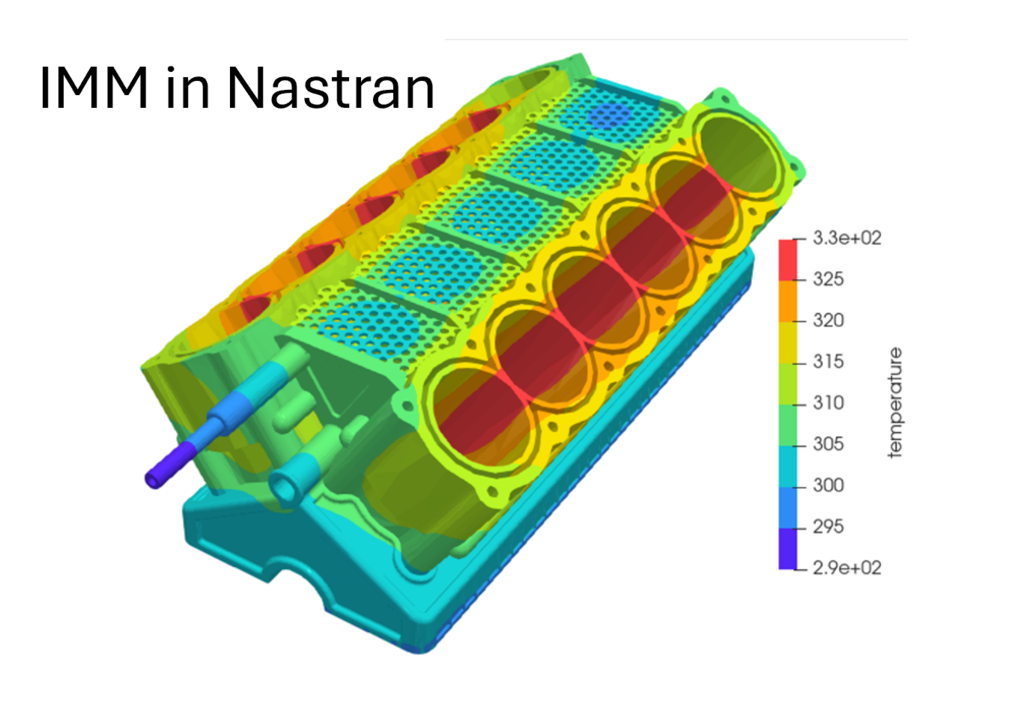
Plug and Play Integration: IMM enables existing solvers to be easily extended to support meshfree simulation. This includes both open-source solvers (e.g., MFEM) and commercial tools such as NX Nastran.
Differentiability: Because moments are integrals of smooth functions, they are naturally differentiable, enabling sensitivity analysis and optimization.
Accuracy and Comparison
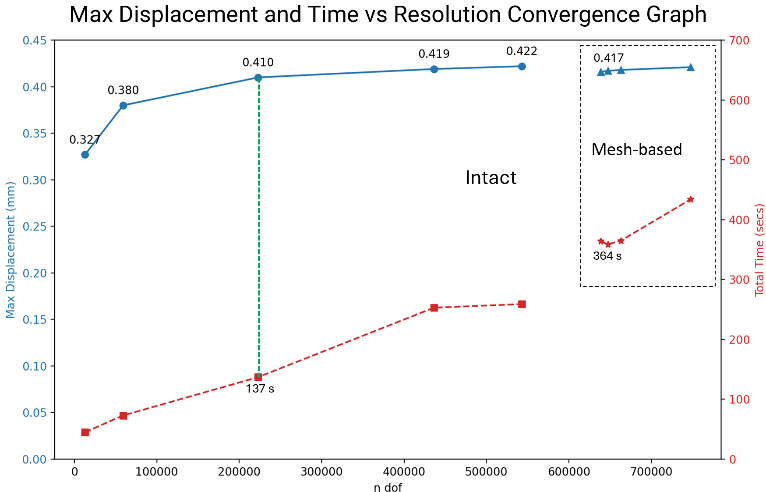
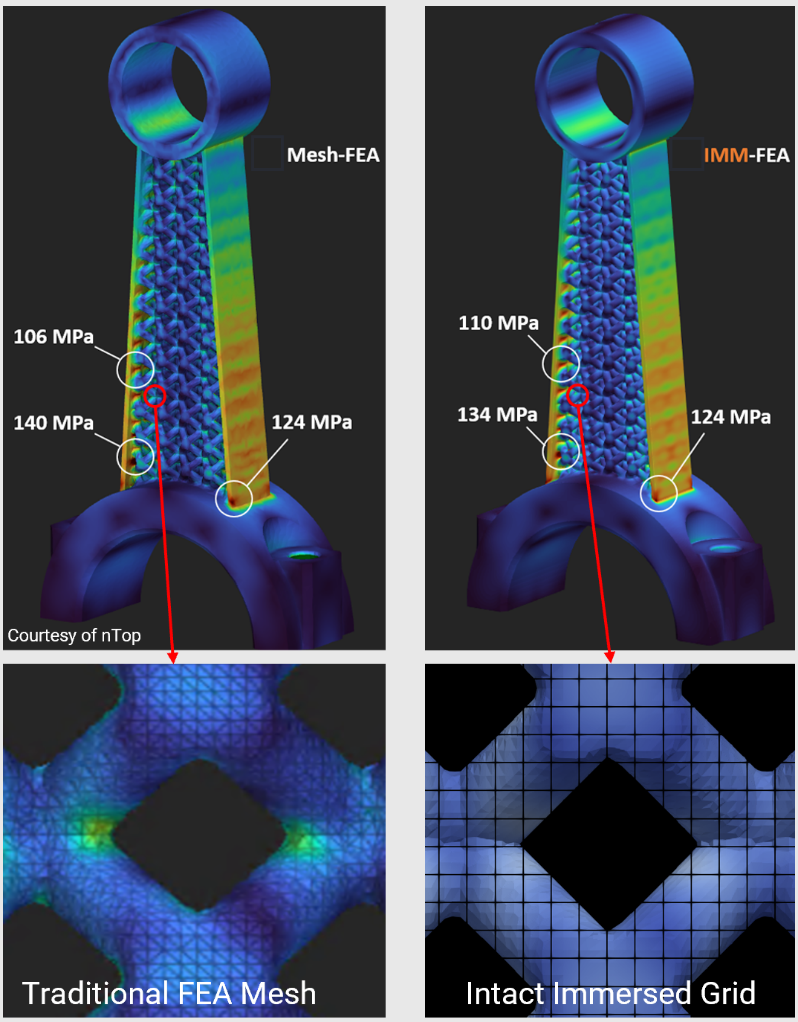
IMM has been benchmarked against conventional mesh-based FEA using stress and deformation results on geometrically complex models. Results show close agreement in displacement (<1%) and stress (<5%). To access full benchmark documents, please contact us.
Conclusion
The Immersed Method of Moments offers a modern foundation for simulation: rigorous, adaptable, and automation friendly. By replacing the fragile meshing step with moment-based integration, IMM brings accuracy, flexibility, and scale to simulation pipelines for today’s most challenging design workflows.